What are OTP messages? You log in to your bank, and a six-digit code lands on your phone. That code is an OTP message. It proves the person typing your password is really you.
An OTP is a one-time password. It works once and then dies. This guide explains the OTP meaning, shows real OTP text message examples, and gives you simple steps to stay safe.
What Does OTP Mean in a Text Message?
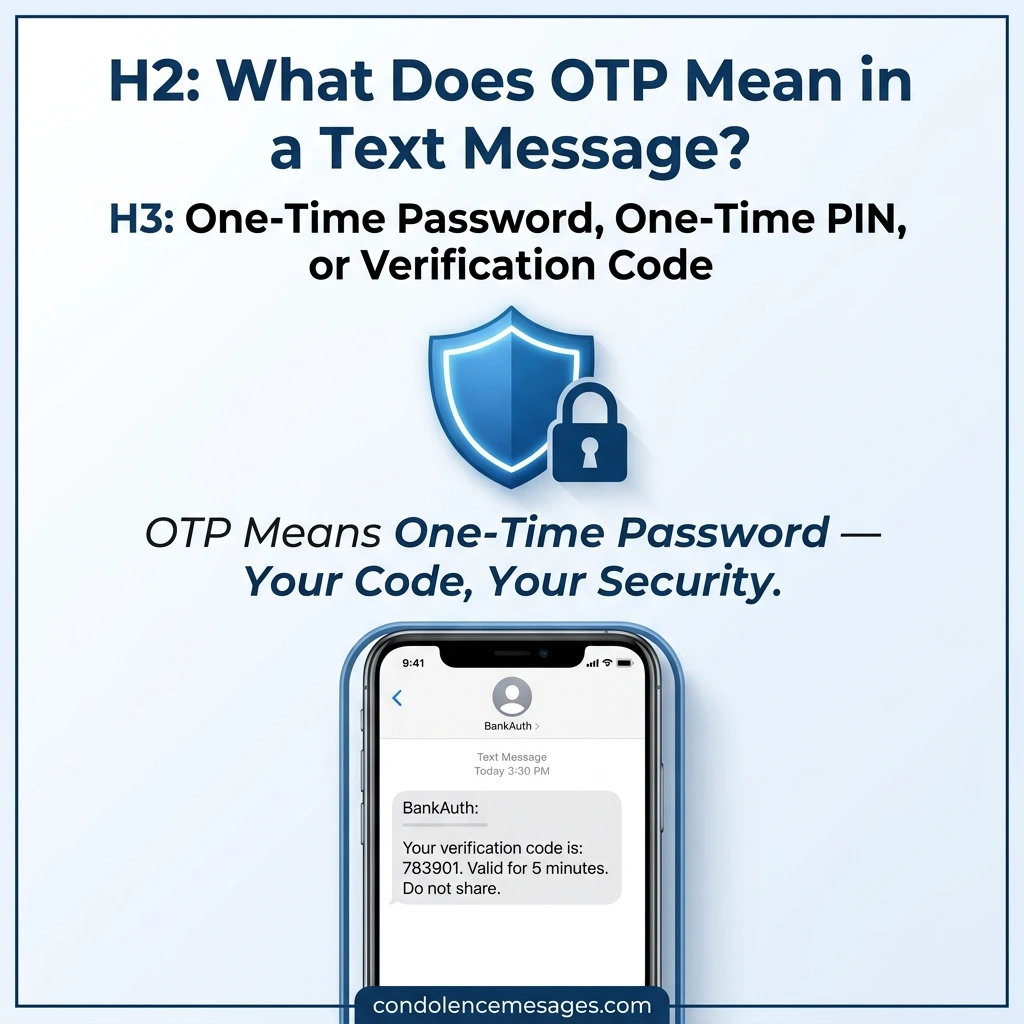
OTP is short for one-time password. You may also see it called a one-time PIN, passcode, or verification code.
What does OTP mean in a text?
It means the message holds a temporary code. The code works for one login session or transaction, as Wikipedia’s overview of one-time passwords explains.
That single-use rule is the whole point. A normal password stays the same for months. If a thief steals it, they can use it again and again. An OTP code is different. Once it is used, it is useless. Security experts call this protection against replay attacks.
How long does an OTP last? Most codes expire in a few minutes. Authenticator apps refresh much faster. The TOTP standard (RFC 6238) uses a 30-second window by default.
Why did I get an OTP I never asked for? Someone may have typed your phone number or email into a login screen. They may also have your password and need your code. Do not share it. Change your password and check your account in the official app.
If your OTP messages are missing from your iPhone or you’re having trouble finding older verification codes, the issue may be related to how your device handles message storage and search. Explore these iPhone message indexing fixes to help restore access to missing texts and find important messages more easily.
How Do OTP Messages Work?
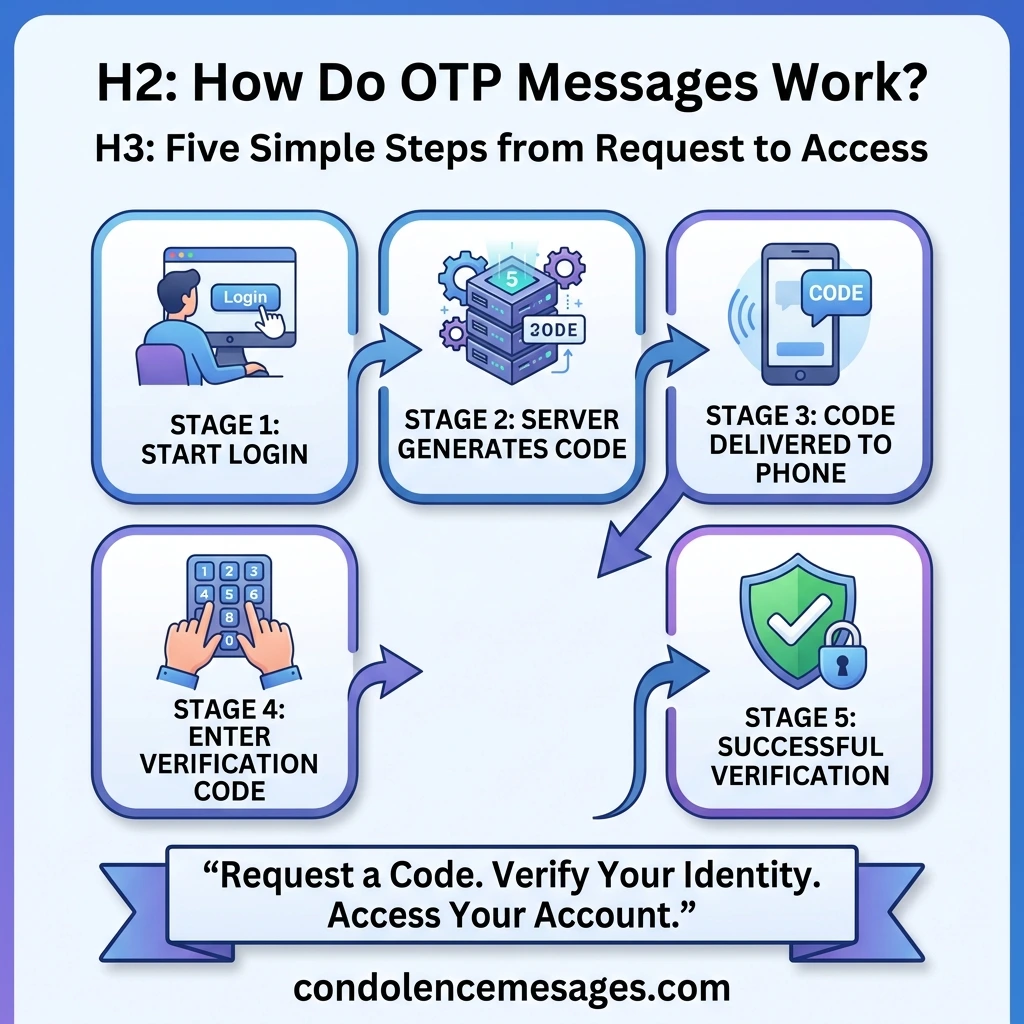
The process is quick and has five steps. You start a login, the server makes a code, and the code reaches you. You then type it in, and the server checks it.
How does OTP verification work?
The server creates a random code tied to your request. It sends the code to your phone number or email. You enter it, and the server confirms it matches and has not expired. Then you get in.
Codes come from two main methods. A TOTP (time-based one-time password) uses the clock. An HOTP (HMAC-based one-time password) uses a counter. The HOTP standard is RFC 4226.
Delivery varies. Codes can arrive by SMS, email, voice call, push notification, or an authenticator app like Google Authenticator, Microsoft Authenticator, or Authy. Some people carry hardware keys like a YubiKey.
OTPs power two-factor authentication (2FA). Your password is something you know. Your phone is something you have. Together they make a stronger lock.
What are OTP messages on Android?
They are texts or notifications with a code. They usually appear in your default messaging app, such as Google Messages or Samsung Messages. Your keyboard may suggest the code to autofill. Google Messages also has a setting to delete OTPs after 24 hours.
Why is my OTP not arriving?
Common causes are weak signal, a full inbox, a wrong number on file, carrier text filtering, or too many requests in a row. In the US, businesses send these texts through short codes or registered A2P 10DLC numbers. Wait a minute, then request one new code. Repeated taps can slow things down.
OTP Message Examples and Common Uses
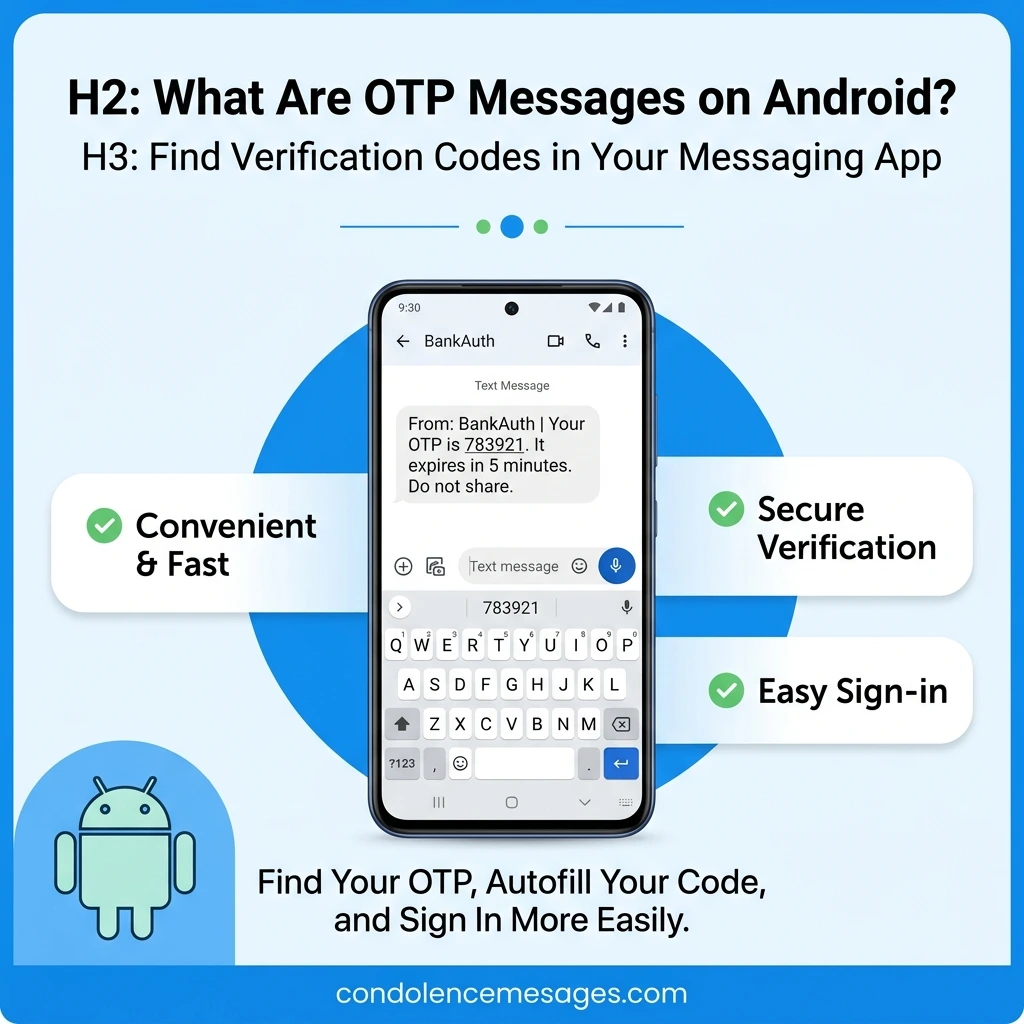
Real OTP texts follow a pattern. They name the company, give the code, state the expiry, and warn you not to share it.
What is an example of an OTP message?
Here are common ones:
Your Northwind Bank verification code is 482913. It expires in 5 minutes. Never share this code. We will never ask for it.
Use code 703168 to approve your card purchase of $48.20. If this was not you, call the number on the back of your card.
Your password reset code is 915274. It is valid for 10 minutes. If you did not request this, ignore this message.
New device sign-in detected. Enter code 360842 to continue. Do not share this code with anyone.
Your delivery driver needs this code to hand over your package: 5127. Share it only at your door.
Notice the pattern. A real message tells you what the code is for. It also tells you to keep it private.
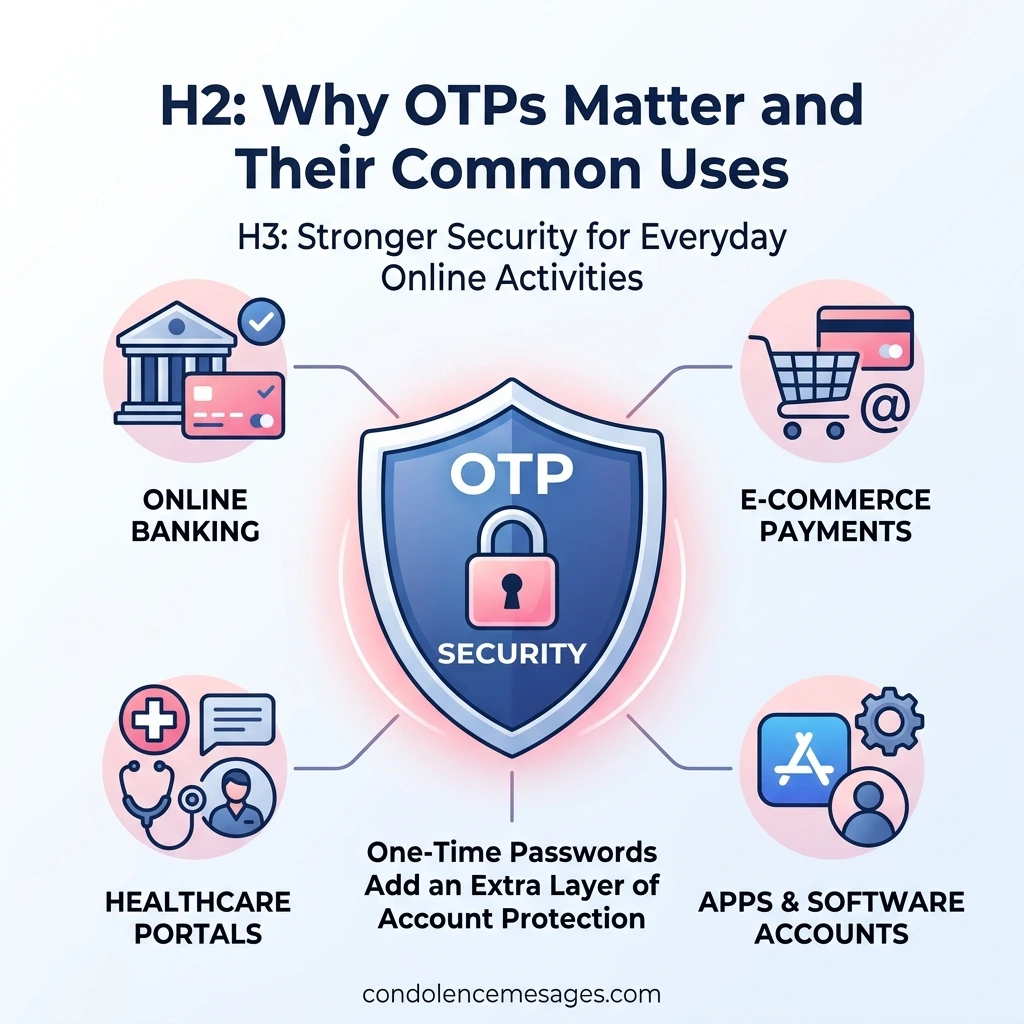
OTP verification protects many everyday actions. Banks use it for logins and large transfers. Online stores use it to confirm payments and new accounts. Healthcare portals use it to guard patient records. Apps and SaaS tools use it for sign-ups and password resets.
The benefits are clear. OTPs block replay attacks. They add a layer when a password is weak or reused. They also help companies meet privacy rules such as HIPAA and GDPR.
OTPs are not perfect, though. The U.S. National Institute of Standards and Technology (NIST) labels SMS-based codes a restricted authenticator. The reasons are SS7 flaws and SIM swaps.
How to Stay Safe From OTP Scams
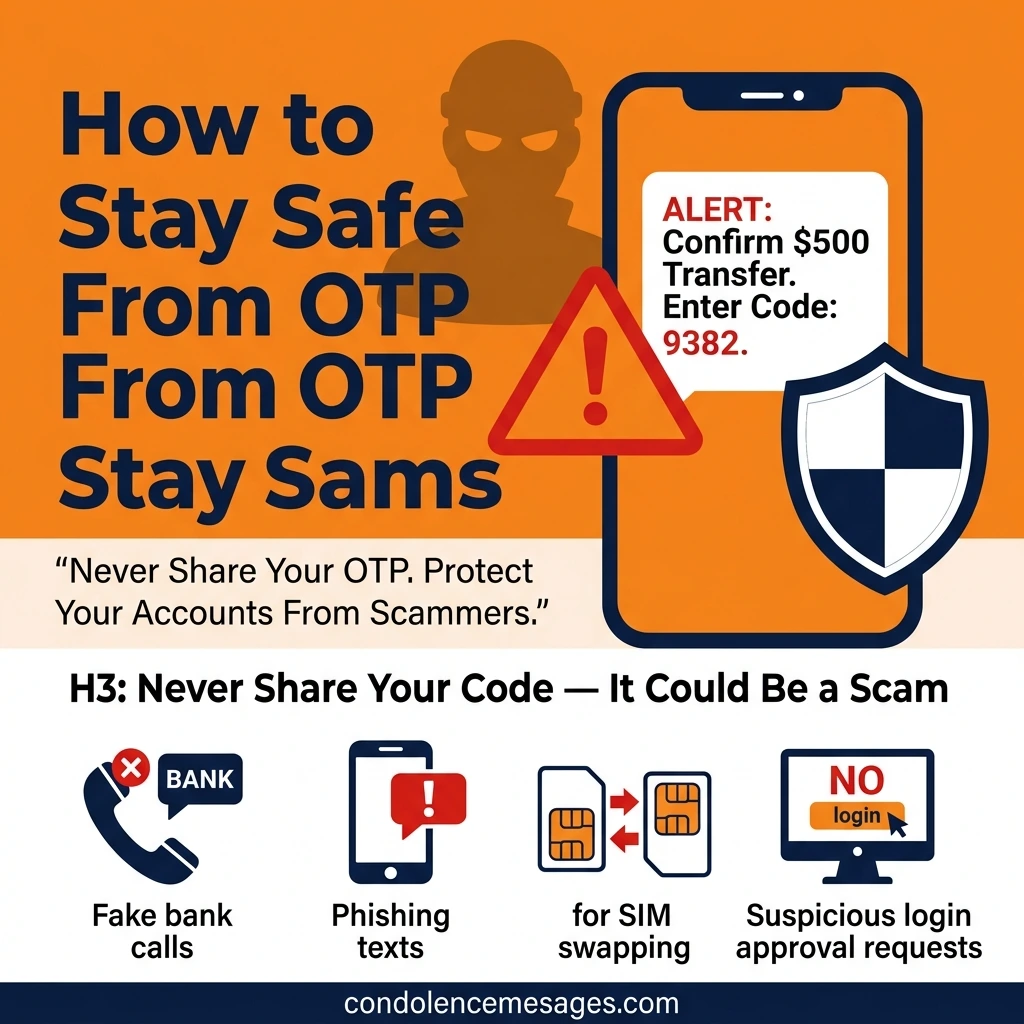
Scammers rarely hack the code. They trick you into handing it over. The fix is one simple rule.
Never share your OTP with anyone. The Federal Trade Commission says that no caller, even one claiming to be from your bank, will ask for a verification code. It also says that anyone who asks for your code is a scammer, and that you should never use the number the caller gave you.
What can someone do with my OTP?
They can use it to prove they are you. That lets them finish a login, reset your password, approve a payment, or lock you out. Banks warn that scammers often already have your password and only need the code.
Watch for these tricks:
- Fake bank fraud calls. The caller says your account is at risk, then asks for the code “to stop it.” Hang up and call the number on your card or statement.
- Smishing. A text with a link asks you to “verify” an account. Do not tap it.
- SIM swapping. A criminal moves your number to their SIM. Codes then go to them. In 2019, attackers hijacked Jack Dorsey’s Twitter account this way.
- SS7 attacks. Flaws in old phone-network protocols can redirect texts. In 2017, attackers used this to drain German bank accounts.
- Push-bombing. You get a flood of login prompts, hoping you tap “approve” to make them stop.
What should I do if I shared my OTP?
Act fast. Call your bank using the official number. Change the password on the affected account. Ask your carrier to add a port-out PIN to your number. Report it at ReportFraud.ftc.gov, and forward scam texts to 7726 (SPAM).
For stronger protection, switch to an authenticator app or a passkey. Passkeys are phishing-resistant sign-ins backed by Apple, Google, and Microsoft. They have no code to steal.
FAQs
What can someone do with my OTP?
With your OTP and password, a criminal can log in, reset passwords, approve payments, or take over your account. The code proves they are you. Never share it, even with someone who sounds official.
What are OTP messages on Android?
They are texts or notifications that carry a one-time code. They show up in your messaging app, such as Google Messages or Samsung Messages. Your keyboard may offer to autofill the code.
What is the difference between OTP and SMS?
SMS is the delivery method. OTP is the code inside the message. An OTP can also arrive by email, voice call, or app. An SMS can also carry other things, like alerts or reminders.
What is an example of OTP?
“Your verification code is 482913. It expires in 5 minutes. Never share this code.” You type the code into the login screen, and it stops working after you use it.
Conclusion:
An OTP message is a small code with a big job. It adds a second lock to your accounts. Keep it private, check the sender, and use an authenticator app or passkey when you can. If anyone asks for your code, treat it as a scam.

Timmy Abu Zar is the writer and voice behind CondolenceMessages.com, dedicated to helping people find comforting words during life’s most difficult moments. With a deep respect for the many ways people grieve and remember, Timmy writes thoughtful, sincere messages and guides to support readers through loss, no matter their background or beliefs.