Scam text messages are everywhere. One buzz on your phone can be a fake delivery notice, a fake bank alert, or a fake job offer.
This guide shows you 105+ scam text message examples, the red flags that give them away, and the steps that keep you safe. Use it to spot fake texts fast.
Scam Text Message Examples: 105+ Fake Texts to Watch For
Scammers pick words that cause fear, hope or panic. Below, the examples are grouped by type so you can match what lands on your phone.
Why do these texts work? The FTC says people reported losing $470 million to scams that began with a text in 2024. That is more than five times the 2020 figure, even though fewer people filed reports.
Package delivery scam texts top the FTC’s list. They claim a parcel is stuck and ask for a small fee. That fee is a trick to steal your card number.
USPS: We could not deliver your package due to an incomplete address. Update it within 12 hours or it will be returned.
FedEx: Your parcel is held at our depot. Pay a $1.99 redelivery fee to release it today.
UPS: Delivery attempt failed. Confirm your address now or your package will be sent back.
Amazon: Your order could not be shipped. Verify your payment details to avoid cancellation.
DHL: A customs fee of $2.75 is due on your parcel. Pay now to avoid storage charges.
Unpaid toll scam texts are a fast-growing smishing trick. They threaten late fees and ask you to pay through a link. You may not even drive on toll roads.
E-ZPass: You have an unpaid toll balance of $6.50. Pay today to avoid a $50 late fee.
Final notice: Your toll invoice is overdue. Pay now to stop extra fees and a possible DMV hold.
Toll Services: Our records show an outstanding toll. Settle it within 24 hours to avoid a fine.
A toll from your last trip was not charged. Update your plate number and pay the balance here.
Your account is flagged for unpaid tolls. Pay now to keep your driving privileges.
Bank fraud alert texts pretend to protect your money. The goal is to get you to call a fake agent or log in on a fake page.
Chase Alert: A charge of $849.99 was made on your card. Not you? Tap here to secure your account.
Wells Fargo: Your account is locked after suspicious sign-in attempts. Verify your identity now.
Bank of America: We blocked a payment of $1,200 to an unknown payee. Call this number to cancel it.
Your debit card has been suspended. Confirm your PIN and card number to restore it.
Fraud Dept: A new device logged into your online banking. If this wasn’t you, log in here right away.
Government impersonation texts use big names like the IRS and Social Security. Real agencies do not demand money or personal details by text.
IRS: You have an unclaimed tax credit. Submit your bank details to receive it.
Social Security: Your number has been suspended due to suspicious activity. Call us right away.
Medicare: Your new card is ready. Confirm your Medicare number to get it mailed.
Your government benefit payment is on hold. Verify your identity to release it.
DMV: Your driver’s license will be suspended in 48 hours for an unpaid fine. Pay now.
Prize and giveaway scam texts promise free gifts for contests you never entered. If you did not enter, you did not win.
Congratulations! You won a $500 Walmart gift card. Claim it before midnight.
You have been picked for a free iPhone. Tap here to claim your reward.
Your number won $1,000,000 in our monthly draw. Reply with your full name to collect.
Your wireless carrier thanks you with a free gift. Claim it within the next 10 minutes.
You’re our lucky winner of a Caribbean cruise. Pay a $29 processing fee to confirm your trip.
Fake refund texts say money is waiting for you. All you need to do is “confirm” your bank or card details.
Our records show you overpaid. Send your bank routing and account number to receive your refund.
Your $312 refund is ready. Confirm your card details to get paid today.
Tax refund approved. Submit your details to accept the deposit.
Your utility company owes you a credit of $146. Claim it here.
Your insurance refund is waiting. Verify your account to release the funds.
Wrong number scam texts start with a harmless hello. The FTC says they often turn into a friendship or romance, then a fake investment pitch.
Hi, is this Ashley? We met at the conference last week.
Sorry, wrong number! You seem kind though. Mind if we chat?
Hey, are we still on for dinner on Friday?
Hello! I found your number in my contacts. How have you been?
I’m a trader and just made a big profit. Want me to show you how?
Family emergency and “new number” texts play on love and fear. They push you to act before you think.
Hi Mom, I lost my phone. This is my new number. Can you text me here?
Dad, I’m in trouble and need money fast. Please don’t call.
Grandma, it’s me. I was in an accident. Please send $900 and don’t tell Mom.
Hey, it’s your sister. My phone broke. Can you buy a gift card for me?
Your son has been arrested. Send bail money now to avoid a longer stay.
Boss and workplace scam texts copy a manager’s voice. They ask for gift cards, wire transfers or login details.
Are you at your desk? I need a quick favor. It’s urgent.
It’s your manager. I’m in a meeting and need gift cards for a client. Can you buy them now?
HR Update: Your payroll details need to be re-entered. Log in here to avoid a delay.
Your schedule has changed. Tap here to view your new shift.
This is the CEO. Wire $4,500 to our new vendor today and keep it confidential.
Fake job offer texts are among the most reported text scams. Many are “task scams” that start small, then ask you to put in your own money.
We’re hiring! Earn $300 a day working from home. No experience needed. Text us on WhatsApp.
Your résumé was selected. Complete a short online task and earn $50 today.
Mystery shoppers needed. We’ll send you a check to cover your first purchase.
Congratulations, you got the job! Buy equipment with the check we send, and we’ll reimburse you.
Part-time job: like videos and get paid per click. Message us to start.
Fake subscription and renewal texts target people who forget what they pay for. They push you to call a number or “cancel” through a link.
Netflix: Your payment was declined. Update your billing details to keep watching.
Your antivirus subscription renews today for $349.99. Call to cancel.
Geek Squad: Your plan has been renewed for $399. Call us if you didn’t approve it.
Spotify: Your account will be closed in 24 hours. Verify your card to stay active.
Your Amazon Prime membership has expired. Renew now at a special price.
Account verification and 2FA texts try to steal your login or your one-time code. Never share a code with anyone.
Your Apple ID has been locked. Verify it now to restore access.
We detected a sign-in to your Google account from a new device. Confirm it’s you here.
Your verification code is 48291. If you didn’t ask for this, tap here to cancel.
Please reply with the code we just sent you so we can verify your listing.
Your Instagram account broke our rules. Appeal now or it will be deleted.
Payment app scam texts copy Zelle, Venmo, Cash App and PayPal. They hint at money coming in, or money going out without your say.
Zelle: A payment of $500 is pending. Confirm your bank login to receive it.
Venmo: You received $250 from an unknown user. Accept it here before it expires.
Cash App: Your account has been limited. Verify your identity to lift the limit.
PayPal: We noticed unusual activity. Log in now to avoid a permanent hold.
Your payment app sent $700 to a new contact. Reply YES to approve or call our support line.
Utility and phone company texts threaten to cut your power, water or service. The fake deadline is the trap.
Your electric bill is overdue. Pay within 1 hour or your power will be shut off.
AT&T: Your bill is ready, and a past-due balance remains. Pay now to avoid service loss.
Your internet service will be disconnected today. Update your payment method here.
T-Mobile: You qualify for a free phone upgrade. Confirm your account PIN.
Your water account has a late fee. Pay now to avoid disconnection.
Debt, court and jury duty texts use fear of arrest or a lawsuit. The FTC has warned that jury duty threats like these are a scam designed to steal your money.
You missed jury duty. A warrant has been issued. Pay a fine today to avoid arrest.
Final notice: legal action will be filed against you. Call our office immediately.
You owe a past-due debt of $1,820. Pay now to avoid wage garnishment.
Court notice: you have a hearing scheduled. Download the file to see the details.
Parking violation: Pay your fine within 24 hours to avoid a late fee.
Health insurance and Medicare scam texts rise during open enrollment. The FTC warns that scammers may even pay to appear at the top of search results, so be careful where you click.
Open enrollment ends soon. Get a health plan at no cost. Reply YES.
You qualify for a free Medicare back brace. Confirm your Medicare number.
Your health insurance has lapsed. Pay your premium here to restore coverage.
Your lab results are ready. Tap here to view them.
Claim your health allowance card worth $2,500. Enter your ID to start.
Credit card and loan offer texts dangle low rates and loan forgiveness. A real lender will not text you out of the blue.
You are pre-approved for a 0% credit card. Confirm your SSN to activate it.
Your student loans may be forgiven. Apply here before the program ends.
Lower your credit card interest to 0% today. Call now.
Your loan of $5,000 is approved. Pay a $100 fee to receive it.
Boost your credit score by 100 points in a week. Reply to start.
Tech support and security alert texts claim your phone or computer is in danger. The “fix” is often malware.
Virus detected on your phone. Tap here to remove it now.
Your iCloud storage is full. Pay $0.99 to avoid losing your photos.
Microsoft Support: Your computer has been hacked. Call us immediately.
Security alert: your number was found in a data breach. Verify your details to stay safe.
Your Wi-Fi router needs an urgent update. Install it here.
Charity, marketplace and rental scam texts target kind and busy people. Fake buyers and fake landlords are common.
Help families hit by the storm. Donate now with this quick link.
Hi, I’m interested in your listing. I’ll pay through Zelle. What’s your email?
Is the apartment still available? I’m out of town and will pay the deposit by cashier’s check.
Your listing code was sent to your phone. Please share it so I can confirm the deal.
I overpaid you by mistake. Please send back the difference.
Texts from your own number and QR code texts are newer tricks. The sender can fake, or “spoof,” the number. QR codes hide the link, so you can’t see where it leads.
Free Msg: Your bill is paid for this month. Here’s a small gift for you. Tap here.
Your account was accessed from your own number. Tap here to secure it.
Scan this QR code to confirm your package address.
Scan to verify your parking payment and avoid a fine.
Your voicemail is waiting. Tap here to listen.
Crypto and AI-written texts are the newest wave. Some now use your name and read like a real person wrote them.
Coinbase: Unusual login detected. Verify your wallet to protect your funds.
Your crypto wallet has been flagged. Call support to unlock it.
Invest $500 today and earn $5,000 in one week. Guaranteed returns.
Join our private investing group on WhatsApp for daily stock tips.
Hi Sam, we spoke last Tuesday about your mortgage. Tap here to see your updated rate.
Sometimes, finding old scam texts can be difficult when your phone’s Messages app is still processing your conversations. If your search results seem incomplete, learn more about Messages finishing indexing and how to restore reliable message search.
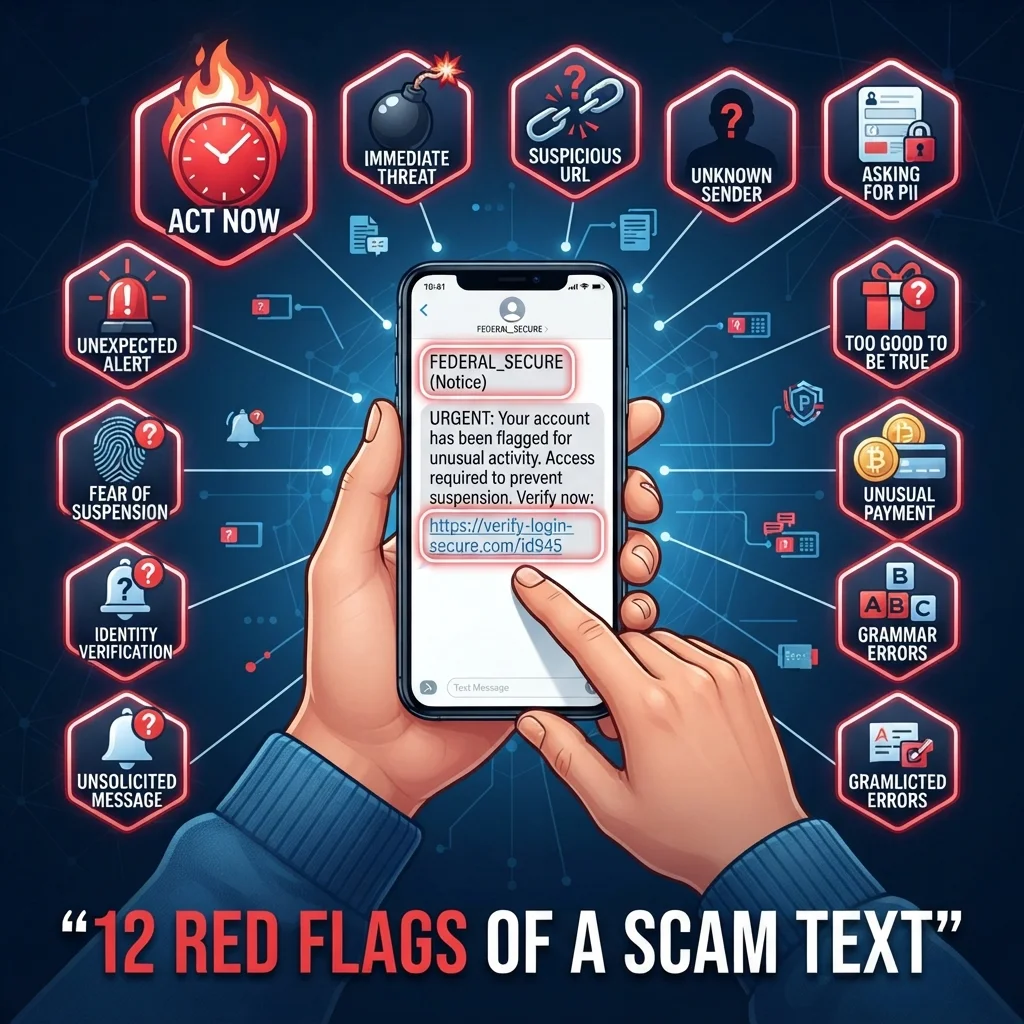
How to Spot a Fake Text Message: 12 Red Flags of Scam Texts
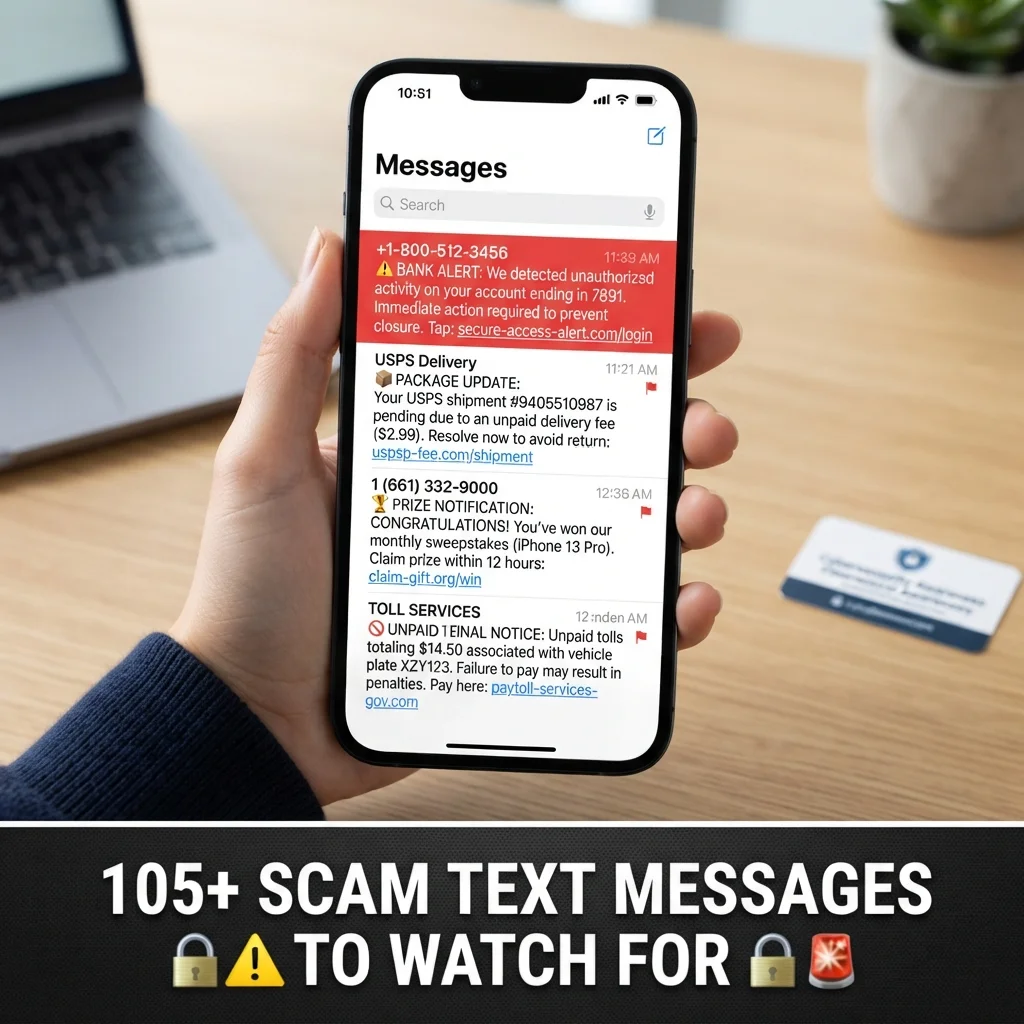
Most fake texts follow the same playbook. Learn the signs and you can spot scam text messages in seconds.
Here are the red flags to look for:
- Urgency. “Act now” or “within 24 hours” is meant to stop you from thinking.
- Threats. Fines, arrest, shut-offs or a locked account are common scare tactics.
- Too-good-to-be-true offers. Free gifts, easy cash and big refunds are bait.
- An unknown or odd sender. Look for a random number, an email address, or a short code you don’t know.
- A generic greeting. “Dear customer” or “Hello” often means a mass text.
- Strange links. Shortened links and lookalike web addresses, such as one extra letter in a brand name, are warning signs.
- Requests for personal data. Banks and agencies do not ask for your Social Security number, PIN or password by text.
- Odd payment methods. Gift cards, crypto, wire transfers and payment apps are favorites of scammers.
- A brand you don’t use. A bank alert from a bank you’ve never used is a clear giveaway.
- A push to switch apps. Being asked to move to WhatsApp or Telegram is a common move.
- A message that looks familiar. Scam texts can land inside an old thread or appear to come from your own number.
- Perfect writing. Typos once gave scams away. Now AI tools can polish the grammar, so clean writing does not prove a text is safe.
How can you tell a real text from a fake one? Ask three quick questions. Was I expecting this? Does it make sense? Who is really asking?
Take a bank alert. A real bank text is short and never asks you to share a PIN. A fake one rushes you and asks you to log in through a link.
How to Avoid Scam Texts and Stay Safe: Block, Report and Recover
A few habits stop most text message scams. Here is what to do before, during and after you get a suspicious text.
What should you do with a scam text? The FTC’s advice is simple. Don’t click any links. Don’t reply. Contact the company using a phone number or website you know is real.
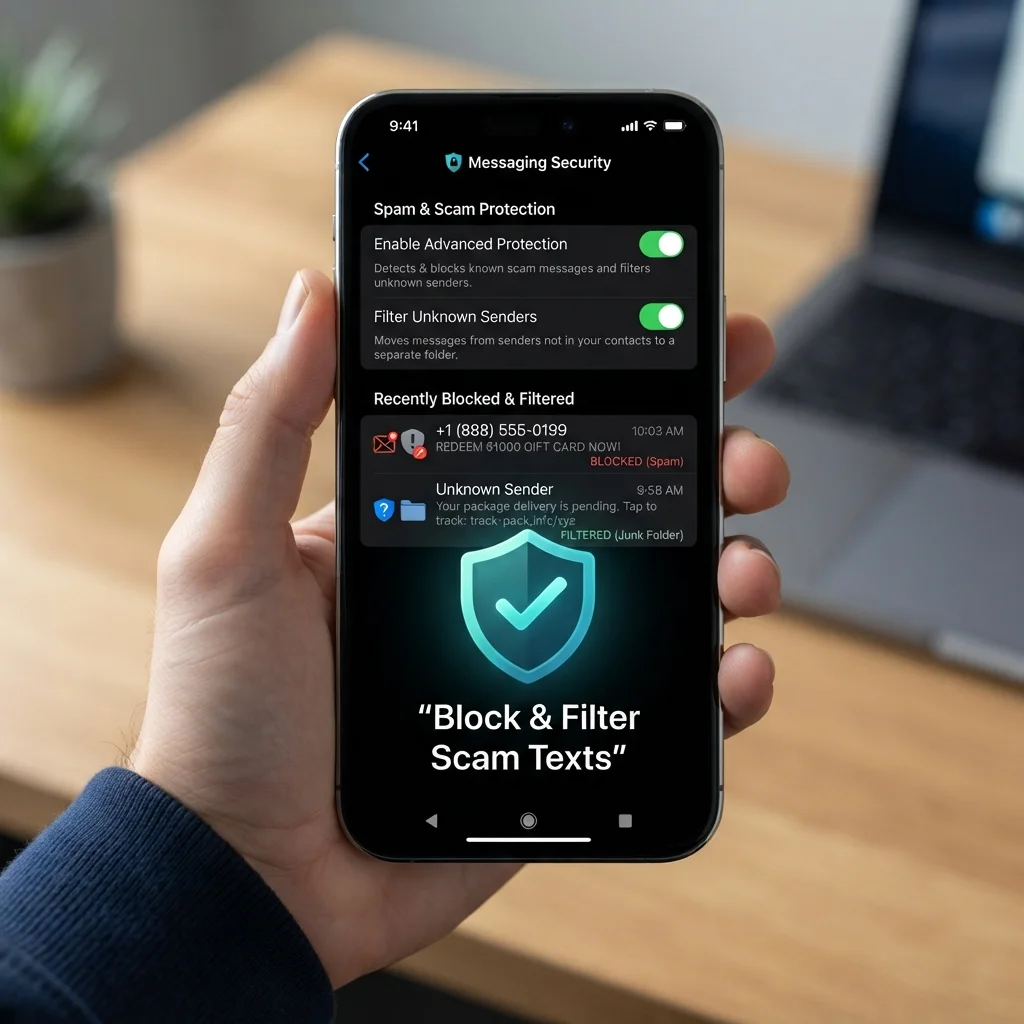
Block and filter at the source. Turn on the filters already built into your phone:
- On an iPhone, go to Settings, then Messages, then turn on Filter Unknown Senders. Tap Report Junk under a suspicious text.
- On Android, open the Google Messages app, press and hold the text, then choose Block and report spam. You can also switch on spam protection in settings.
- Check your carrier’s tools. AT&T, Verizon and T-Mobile all offer free scam-blocking features.
- Add a trusted spam-blocking app if you want an extra layer.
Report every scam text. It helps shut scammers down. You have three choices:
- Forward the text to 7726 (SPAM). This helps your carrier block similar messages.
- Report it to the FTC at ReportFraud.ftc.gov.
- If you lost money, also file a report with the FBI’s Internet Crime Complaint Center (IC3).
Should you reply STOP? Don’t reply to a scam text. A reply can show the scammer that your number is active. Block and report instead.
What if you clicked a link? Act fast, and don’t panic:
- Run a security scan and update your phone’s software.
- Change passwords for your bank, email and social media accounts.
- Turn on two-factor authentication for every account you can.
- Call your bank or card issuer and watch your statements.
- Place a fraud alert or a credit freeze with the credit bureaus.
- Review your credit reports at AnnualCreditReport.com.
- Build a recovery plan at IdentityTheft.gov.
What if you sent money? Call your bank or the payment app right away and ask if the payment can be stopped. If you paid with a gift card, contact the card company. Then file your reports. The sooner you call, the better your chances.
Protect your family. Warn older relatives and teens about common tricks. Share screenshots of scam texts in your family chat, then delete the message after you report it. The National Cybersecurity Alliance also suggests asking a second person to look at anything suspicious.
Remember the rule: Stop, Check, Protect. Pause first. Verify on your own. Then protect your accounts.
FAQs
Is there a scam going on with text messages?
Yes. Scam text messages are widespread across the U.S. The FTC says people reported losing $470 million to scams that started with a text in 2024. The most common types are fake package alerts, fake job offers, bank fraud alerts, unpaid toll notices and wrong number texts.
How to identify a fake text message?
Look for urgency, threats, strange links, unknown senders and requests for personal data. Be wary of offers that sound too good to be true. A real company will not ask for your PIN, password or Social Security number by text. When in doubt, contact the company on a number you find yourself.
Can I get scammed if I respond to a text message?
Yes. A reply can confirm your number is active, which brings more spam. It can also start a chat that leads to a payment scam. The biggest risk comes from clicking links or sharing codes and personal details. If you replied, block the number and report it.
What are some examples of scam text messages?
Common examples include fake package delivery texts, unpaid toll notices, bank fraud alerts, IRS or Social Security warnings, prize wins, refund offers, job offers and wrong number texts. You will find 105+ real-style samples above, grouped by type, so you can match what you receive.
Conclusion
Scam text messages change fast, but the warning signs stay the same. Urgency, odd links and requests for money or data are the big ones.

Timmy Abu Zar is the writer and voice behind CondolenceMessages.com, dedicated to helping people find comforting words during life’s most difficult moments. With a deep respect for the many ways people grieve and remember, Timmy writes thoughtful, sincere messages and guides to support readers through loss, no matter their background or beliefs.